Subscribe:
Showing posts with label christian. Show all posts

Wednesday, November 27, 2013

Construction Paper & Mickey Molds

Weighing heavy on me recently has been the realization that I may not know or be known by God.

Sure, I know about him, and I can discuss propitiation VS expiation, or the natural headship of Adam VS the federal headship of Adam, or define justification or righteousness or holiness or many other theological terms, but I'm not sure I've ever been...transformed. Completely changed. Had my spiritual deadness exchanged for spiritual life in Jesus.

So what gives with my Christian appearance? I think of it in two analogies, both of which fail to truly nail the core issue. What I'll do then is briefly summarize what the Bible says on the issue.

1. The Construction Paper Christmas Tree

Since I'm contemplating this around the holiday season, it was only natural that my mind would lean towards Christmas-y thoughts.

When I was in elementary school, around this time of year we would begin cutting out the shapes of Christmas trees, ornaments, tinsle, stars, angels, and presents from brightly colored construction paper. After juxtaposing all of the shapes in various positions, it's time to bust out the Elmer's glue and lock in the final design. After a period of allowing the freshly-glued tree to dry you had something you could proudly display on the refrigerator at home: a carefully crafted construction paper Christmas tree.

However, once my craft is hung on the fridge, I'm not going stack presents in front of my refrigerator door, am I? Heavens no! How would I get to my eggnog then?! No, the fact of the matter is that my craft-time creation is NOT a Christmas tree. It looks sort of like one, with the same basic shapes and colors, but it is not actually a fir tree purchased from a lot or cut down from the Pacific Northwest. I have simply conformed my paper to represent whatever image I wanted - in this case, a Christmas tree.

What's the spiritual picture I'm trying to draw?

The construction paper is me in my spiritual deadness, my sin, my old man, my flesh, my unregenerate self. The Christmas tree shape is analogous to the "Christian image", and the real Christmas tree would be the real, born-again Christan.

Having grown up in the church, I have had plenty of time to figure out what a Christian should look like, and I have been able to carefully adjust myself to look like a born-again believer. A snip here, a clip there, paste another embellishment or two, and voilà! A Christian! But...not really. I'm not REALLY a Christian at this point, right? I've just conformed my deadness to look like life. The problem is that I've done this with really big construction paper, and because I'm life-sized, I can't tell myself apart from actual Christians, and so I grow to believe that I show all the signs of a true believer.

Now, this analogy breaks down because construction paper (for the most part) is made from trees. Construction paper and a Christmas tree have more in common, by virtue of their tree-ness, than a spiritually dead person and a spiritually living person.

2. The Mickey Mouse Mold

If you ever travel to EPCOT at Walt Disney World, you'll have the opportunity to purchase a guided tour called "Behind the Seeds", which takes you into the wonderful world of gardening, hydroponics, and farming. On this tour, Guests are shown something quite spectacular: pumpins shaped (more or less) like Mickey Mouse's famous silouhette. How is this done?

When the hydroponically grown pumpkins are still quite small, they are placed inside of a specially-designed mold. As the pumpkin increases in size, its rind conforms almost perfectly to the mold. The result? A pumpkin that, in the wrong lighting, could be confused for the Head Cheese himself.

Spiritual picture? Glad you asked.

The pumpkin is me in my spiritual deadness. The mold is the Christian image, and Mickey would be the actual Christian.

When I was born, I was born in sin, and that sin produced death within me. Because I grew up in church, I was able to conform my outward appearance to look very Christian-like, but there was never any life inside of the shell. A true Christian, however, is self-authenticating: he looks like a Christian because he IS one. Mickey doesn't have to try to be himself, nor did he grow in a Mickey-shaped mold; he looks like himself because...well, because he's Mickey.

This analogy is a little better, but it still breaks down because both a pumpkin and Mickey are alive (I realize Mickey is a cartoon. Just humor me), whereas a spritually dead person, not matter how shaped or formed, is dead, and a spiritually living person is alive.

The Bottom Line

The bottom line is this: I have spent a grand portion of my life crafting this image of myself, growing into a Christian mold, and all the while there has been nothing but death and decay on the inside. Jesus said to the Pharisees that they were "white-washed tombs", pristine on the outside but full of bones and rotting, stinking flesh inwardly. Boy, can I ever relate to that!

The Bible, in no uncertain terms, states that we are not in need of outward conformity to divine or moral principles; what we need is a total transformation from one thing (death) to an entirely different thing (life). You can keep cutting and coloring that construction paper from now until Christmas of 2391 AD, but it's never going to be an actual Christmas tree. Jesus explained to Nicodemus in John 3:1-21 that in order for a person to see the kingdom of God, he must be born again of the Spirit. He says elsewhere that to receive this new birth what one must do is repent of their sin and believe his words, trusting him fully.

I suppose all I'm saying is that God is opening my eyes to the fact that I need something in me, something beyond anything I can accomplish. I could have told you that when I was 5, but now...it's becoming a reality.

I can cut some paper and make it look like a tree, but only God can produce a tree from nothing; Disney can mold a pumpkin to look like Mickey, but only God can call light out of total darkness; I can conform my outward image to feign the presence of life, but only God can spark and sustain true life in me.


Wednesday, October 2, 2013

Good Works: Why do we have them?


An acquaintance of mine recently asked this question via Twitter:


"Why do we have works? Is it for outward performance? Or is it inward, an issue of the heart?"

Definitely a valid question. And these are my thoughts.


I believe that the answer is: both. Good works are both inward and outward; they have a single purpose, but are complex in their makeup; good works seek to achieve one goal, and they do so when a couple of different parts, namely that which is visible and that which is invisible, work together. What is visible is the good work itself - cooking for someone, working on someone's house, community service, etc. What is invisible is the heart and goal behind the good work - hypocrisy, authenticity, pride, humility, jealousy, and the list goes on and on. When the visible and invisible line up properly, the God-designed goal of good works is achieved - glorifying God by way of loving people.


The Visible

What is more glorifying to God than accurately representing him to a world that has never seen him? We have eyes that were created to behold the glory, beauty and love of their Creator, but so few eyes have actually rested on them. It makes sense. "...All have sinned and fall short of the glory of God" (Rom. 3:23). There is no individual who, by virtue of their broken humanness, naturally displays the essence of God to the world - love (1 John 4:8). But thankfully, we have a Messiah who came to restore that which was broken, and believers have not only been fixed by God, we actually have his presence dwelling in us, and his love has been poured into our hearts (Rom. 5:5). So now, even though "no one has seen God at any time", "if we love one another, God abides in us and his love is perfected in us" (1 John 4:12). There is a very real sense in which when believers love people, God himself is manifested to them through the love of the believer. This is the visible portion of a good work, and it's ultimate end is that people may a) see God, the one whom they were made to see, by way of b) actually seeing, receiving, and resting in the love that is manifested in the lives of believers. This makes God tangible and brings God glory.


The Invisible

But then there is the invisible portion of the good work - our motive. Nothing is done without some kind of motive behind it. Is our motive in doing a good work to be seen by men? If so, we fit Jesus' definition of a hypocrite (Matt. 6:1, 2, 5, 16). Is our goal in serving someone to give ourselves proof of our own salvation (in accordance with Phil. 2:12)?** Then the good work rings hollow, and we make God to be disingenuous (not in a substantive way, but in an apparent way to the unbelieving world). In other words: if our goal in loving people is anything other than actually loving them, we not only display an inauthentic affection that leaves a bitter taste on the tongue of those who taste it, we also misrepresent God. If I treat people as tools to assuage my own insecurities regarding my salvation, in my manipulation I actually portray God as manipulative & disingenuous; a fraud. Instead, genuine care for others is self-authenticating - it will appear genuine by virtue of its genuineness. God does not just appear to care for people; God actually cares. When we actually care, this authenticates God and brings God glory.

(As you can see, it is difficult to talk about the invisible without speaking in terms of what is visible, and it is difficult to talk about those without speaking of what they are accomplishing. I believe that's how it should be. And as difficult as it is to speak of them separately, it is actually impossible to live separately. The inner life and outer life are inseparable.)


What are they for?

Analyzing our own good works should be, I believe, a retrospective exercise. Instead of serving someone to verify for myself whether I am saved or not (which warps the purpose of service and displays a misunderstanding of justification), service and good works should be flowing out of my life as a fruit of my Gospel-rooted love and compassion for people; and then, weeks and months down the line, I will be able to look back and rejoice that truly "it is God who is at work in [me] both to will and to work for his good pleasure" (Phil. 2:13). We are, in fact, made for good works (Eph. 2:10), and we can look forward to walking in those works for the glory of God which, as a byproduct, does bring a deep satisfaction. As we walk in righteousness, people will see a true expression of who God is, which may then result in their glorifying our "Father who is in heaven" (Matt. 5:16). 

So what's up with good works? Are they for outward performance or are they an inward issue? I say they are for both. Outward - for the visible glory of God; inward - for the heart-exalting glory of God; in total - for the glory of God.

What do you all think? 


Saturday, August 31, 2013

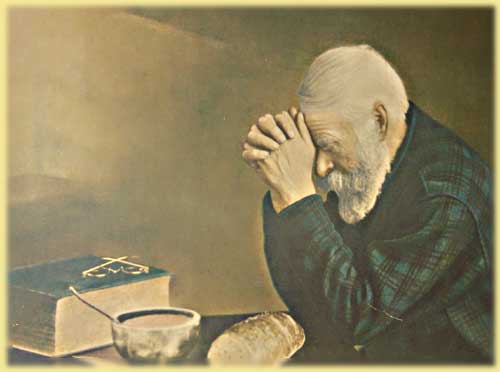
Pondering. Praying.

Let's be honest here: most Christians would rather get an hour long deep-tissue massage from Ironman when his repulsor blasters are malfunctioning, or pet a cat, or pour Tobasco sauce in their eyes, or do anything else rather than pray.

Actually, that's not true. I could only do 30 minutes, not an hour.

Or perhaps a more accurate statement would be, "most Christians would find it easier to endure [insert something horrible and outlandish here] rather than pray". Biblically, we read that this should not be so; but practically, I think we can all relate to this inner tension - a desire in our renewed selves to pray, but the overpowering resistence of the old man against our spiritual endeavour. In the Christian there is a Spirit-born desire, in the core of his being, for prayer. We know that prayer is powerful, that it is effective, and that it is essential to a flourishing Christian life; we know that it is a spiritual weapon with which we wage spiritual warfare; we enjoy theorizing what it would look like to lead a life of deep prayer; we study and analyze the great prayers of Scripture, from Nehemiah to Jesus to Paul, in order to correctly formulate prayers; we read the literature from those great Christian mystics who have reckoned prayer as necessary for spiritual life as their very breath for physical. But then...

...we don't pray.

Let me make it more personal. I don't pray. At least not very often. You may pray on a regular basis, and if you do, I commend you for it. I really hope to be like you one day very, very soon. Surely you are seeing God move in your life and in the lives and situations of those for whom your are praying. Surely God is manifesting himself to you through those intimate times. If that is you, I beg you: press on! Keep praying! Do not grow weary in performing labor that sends ripples through the fabric of the spiritual realm! God hears your prayers; indeed, he even inclines his ear towards the prayers of the righteous person. So please: don't stop. Please continue to set the example for weaker brothers and sisters; for those who are struggling; for me.

So, if I'm not praying then what am I doing? What else is there to do? Well, I am a ponderer. I ponder things. I get an intense joy out of thinking about things deeply, mentally disassembling every cog, wheel, bolt, and spring of a matter in order to understand its inner workings and thereby form my own opinion of and more thoroughly appreciate that matter in its entirety. I especially enjoy pondering theological matters, as theology is an attempt at describing God and everything that is related to him, which is...well, everything. In him we live and move and have our being; he holds all things together with the word of his power. If God is the reason for all of the existing universe, then I can't see there being any other subject as being more worthy of my intense, focused pondering.

Pondering, thinking, meditating; whatever you want to call it, the activity that takes place in the grey matter between our ears has a significant place in Scripture:
  1. The one who meditates on the laws of God are compared to a tree who is planted by streams of water, whose leaves never wither and whose branches bear fruit in its season,
  2. We are encouraged by Paul to dwell on heavenly things, things that are just, lovely, pure, excellent, and worthy of praise,
  3. Paul also tells us in Romans to be transformed by the renewal of our minds,
  4. Peter likewise places a large emphasis on the thought life in 1 Peter, and
  5. In one of the most well-known passages of Scripture, we are told to love Yahweh our God with all of our heart, mind, soul, and strength.
The Christian life is one that is lived and fought primarily in the mind. It is the thought life of the believer that often determines whether a particular skirmish - with the flesh, with sin, with the devil - is won or lost. It is with our minds that we mull over and analyze and understand the precious truths of Scripture. For example, when I come up against a battle with my lust, it is with my mind that I dwell upon the verses that deal with lust and sexual immorality; it is with my mind that I understand the perverse nature of pornography, and its correlation with the sex trafficking industry and other sexual crimes; it is with my mind that I perceive the pain that my lust brings to my wife, and the offence that indulging in lust causes God. I then determine that gratifying my lustful desire is not something that is beneficial for anyone. It is with my mind that I am able to receive information in order to make use of it.

But to only think is not the full picture of the Christian life that we are given in the Bible. It is prayer that calls down fire from heaven; it is prayer that changes the hearts of kings and rulers; it is the prayers of the righteous that God responds to and delivers them out of their troubles, it is prayer that heals men of sickness and demonic influence. And yet not prayer, but the God to whom we pray.

With our minds we can do the work of a tactician, correlating information to make a plan; but it is with prayer that we invoke the presence and power of God to set that plan into action. A plan is great, but what good is a plan if it is never acted upon? Jesus said, "If you know these things, blessed are you if you do them" (John 13:17). And how can we do divine work without divine power? We can't. And because we cannot, we pray that we might be able to. By his grace, God responds if what we are asking him to accomplish is in accordance with not only his nature, but also his will.

What am I saying? In a nutshell, just this: I tend to think a lot, but I pray very little. I reckon that if I had split my time 50:50, or even 70:30, between thinking and prayer, I would have experienced much more victory, power, growth, and maturity in my life than I have thus far.

My desire is to pray more. Not to show you that I am a spiritual person, or to make you esteem me any higher. No, I desire to pray more because it is in the presence of God that we are humbled and made to be a more useful tool in his hand; I desire to pray more because I desire to accomplish his will here on this earth; I desire to pray more because for the rest of eternity I will be in his presence, and if that will be my position for eternity it makes no sense to not be in his presence now. If we cannot enjoy the presence of God on earth, what makes us think we will enjoy it in heaven?

If, when you think about prayer, a back rub from Ironman still seems like a better alternative, then I pray that God would meet you in those moments and show you the value of prayer. It is my prayer that we would not only do the important work of pondering, but also the powerful work of praying.